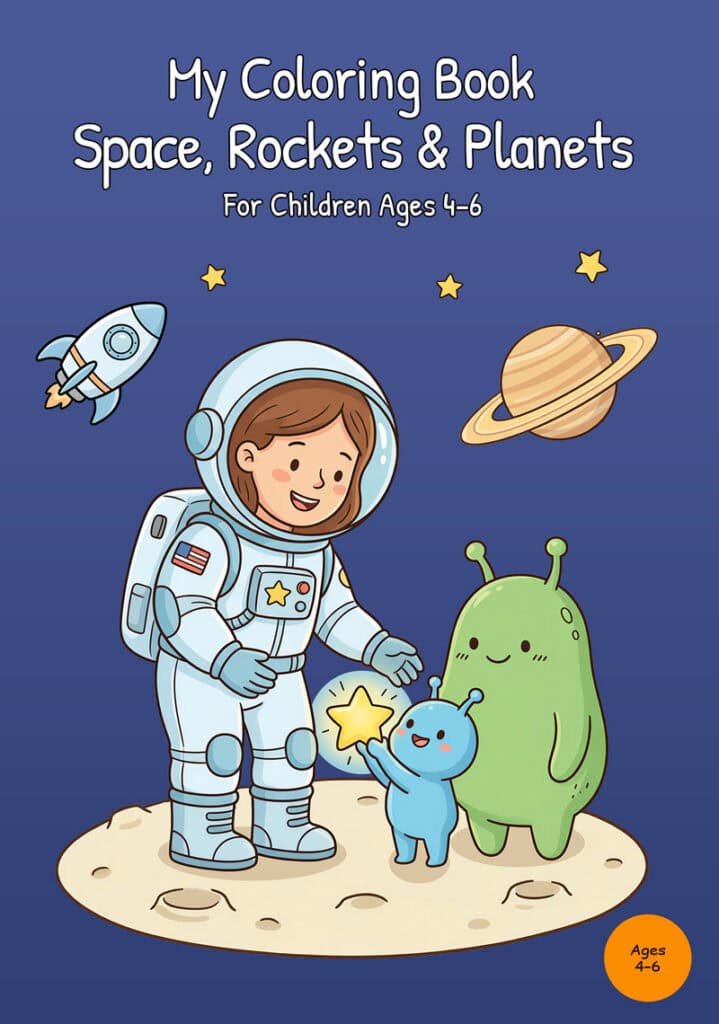

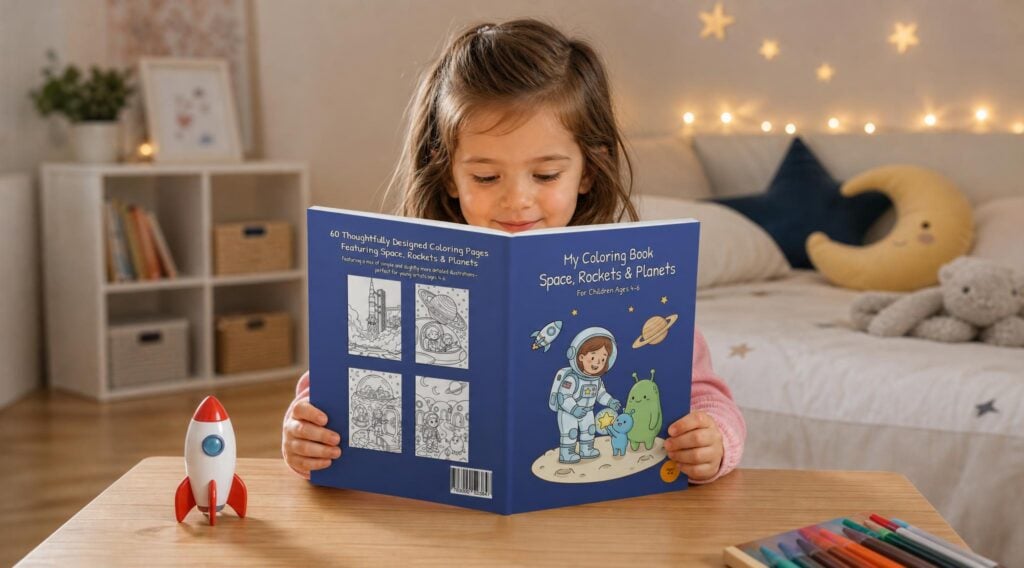
My Coloring Book
Space, Rockets & Planets: For Children Ages 4–6
Note: The buttons lead to Amazon or Etsy. As an Amazon Associate I earn from qualifying purchases. Sylwias Ausmalwelt may receive a credit toward Etsy fees when you purchase through our Etsy link. The price you pay stays the same.
We hope you enjoy our creative ideas!
🧒 Age: 4–6 years
📄 130 pages – with 60 varied coloring pages
🖍️ Ideal for colored pencils, crayons, and washable markers for children
📐 Format: 8.27 × 11.67 inches (A4)
🖤 Black page backs – better protection for the next coloring page
🚀 My Coloring Book Space, Rockets & Planets: For Children Ages 4–6
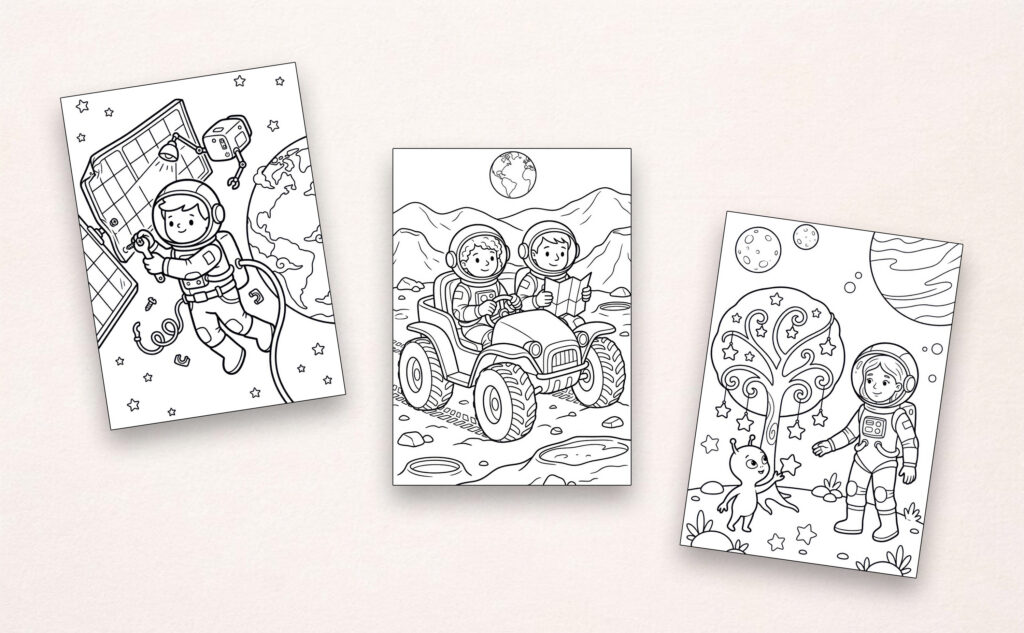
A rocket lifts off from the launch pad, an astronaut explores the Moon, and a rover crosses a rocky lunar landscape. Each page opens another small view of space to color and explore.
My Coloring Book Space, Rockets & Planets brings together 60 coloring pages for children ages 4–6. Astronauts, rockets, planets, moons, a satellite, a telescope, a lunar rover, an observatory, and imaginative space characters give the collection a wide range of subjects.
Some illustrations focus on one large, easy-to-recognize subject, while others add stars, cratered ground, equipment, vehicles, or several characters. Children can choose a straightforward page for a shorter coloring session or spend more time on a scene with smaller details.
🎨 Free Coloring Pages From This Book
If you’d like a little peek inside the book, you’ll find a few selected sample pages here to download and print for free.



🚀 Rockets, Spacecraft, and the Start of a Mission
Rockets give the book some of its biggest, boldest shapes. Children can color a rocket on the launch pad, watch one rise through clouds and exhaust, or move to scenes where spacecraft are already traveling among stars and planets.
The mission theme also brings in astronauts, spacesuits, helmets, and equipment. A page may center on astronauts preparing for a mission, while another shows an astronaut inside a spacecraft or a space station scene. These settings introduce smaller technical details without turning the book into a science lesson.
A lunar rover adds another kind of vehicle. Its large wheels and smaller technical details create a different coloring experience from the long vertical shape of a rocket. Children can move from launch scenes to exploration scenes without repeating the same composition.
🌕 Across the Moon and Mars
Several pages leave Earth behind and move onto rocky landscapes. An astronaut can stand on the Moon, a rover can travel across the lunar surface, and craters, stones, ridges, and distant horizons give the pictures a sense of place.
Mars appears as another destination, bringing a new landscape for astronauts and vehicles to explore. The settings provide different terrain and background elements to color, while children remain free to use familiar grays and reds or invent an entirely different palette.
🔭 Telescopes, Planets, and Looking Into Space
Not every page begins with a launch. A telescope and an observatory bring the viewpoint back to Earth, where children can imagine looking toward the Moon, stars, and distant planets before a mission ever leaves the ground.
A satellite and a space station extend that idea into orbit. Their panels, antennas, windows, and geometric parts contrast with rounded planets and open star fields, giving children a different set of shapes from the astronaut and alien scenes.
Planets, moons, stars, a shooting star, and a comet add still more variety. Children can color a ringed planet with warm bands or cool blues, while stars and comet trails can stand out in bright colors against the rest of a scene.
👽 Friendly Aliens, Robots, and Imaginative Space Scenes
Alongside the recognizable space-exploration scenes, the book includes friendly little aliens and space robots. Their rounded bodies, antennae, faces, and mechanical details create playful subjects that look very different from rockets or observatories.
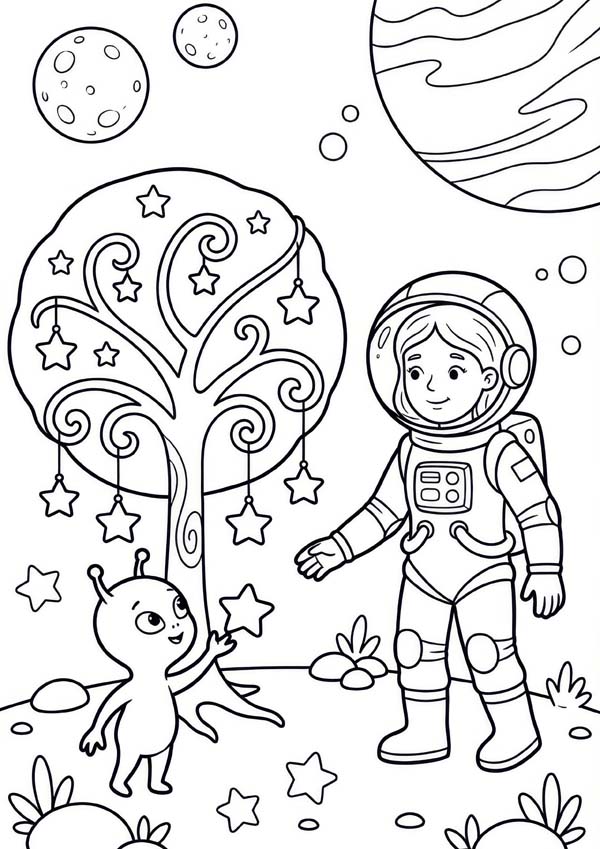
One of the sample pages adds an especially imaginative scene: a child in a spacesuit stands beside a small alien near a tree decorated with hanging stars, while planets and moons appear in the background. Other fantasy settings can place space characters among unusual buildings or distant worlds.
Because these pages are imaginary, color choices can be completely open. An alien can be green, blue, striped, or spotted; a robot can have bright panels and buttons; and children can give a faraway landscape any colors they like.
🖍️ Simple Pictures and More Detailed Space Scenes
The 60 illustrations combine clear, easy-to-recognize subjects with pages that include a little more detail. Some pictures center on one astronaut, rocket, or planet, while others bring together vehicles, equipment, scenery, and several characters.
Across the book, children will find:
- Astronauts on the Moon, in spacecraft, and preparing for missions
- Rockets on the launch pad and traveling through space
- A lunar rover, a satellite, and a space station
- Planets, moons, stars, shooting stars, and comets
- A telescope and an observatory
- A Mars landscape and a ringed planet
- Friendly aliens and space robots
- Simple compositions and slightly more detailed scenes
This range makes it easy to pick a page according to interest and available time. A large rocket or single planet can suit a quick coloring break, while a rover scene or a picture with several characters offers more individual areas to color.
The shapes change noticeably from subject to subject. Long rocket bodies, round planets, segmented spacesuits, rover wheels, telescope tubes, robot parts, and star-filled backgrounds each invite different kinds of strokes and color choices.
The pages do not need to be colored in sequence. A child can jump from a Moon scene to a telescope, choose an alien next, and return to a launch page later. The shared space theme keeps the book connected while the individual scenes remain distinct.
🖍️ Coloring Tools for Rockets, Planets, and Small Details
The pages work well with:
- Colored pencils
- Crayons
- Regular markers
Colored pencils are useful for spacesuit panels, telescope details, stars, and smaller equipment, while crayons can cover broader areas such as rockets, planets, skies, and rocky ground. Regular markers can create bolder blocks of color.
When using markers, place an extra sheet of white paper beneath the page being colored. Markers that lay down a lot of ink and watercolor paints are not recommended. The back of each coloring page is printed black to help protect the following page.
🎁 A Space-Themed Gift for Young Explorers
My Coloring Book Space, Rockets & Planets is a thoughtful choice for children ages 4–6 who enjoy astronauts, rockets, the Moon, planets, robots, aliens, and imaginative journeys beyond Earth.
It can be given for a birthday, used in preschool or kindergarten, packed for vacation, brought out on a rainy day, or saved for a creative break at home. With 60 pages moving between launches, lunar landscapes, observation tools, distant planets, and playful space characters, children can choose a different kind of space scene each time.
Explore All Books in the “My Coloring Book” Series for Children Ages 4–6
Know a family who might enjoy this book?
Share it on Facebook, Pinterest, or WhatsApp.