Drawing Games for Kids: 94 Creative Drawing Challenges and Activities
These include quick drawing activities, challenges with clear rules, drawing games, parent-and-child activities, imaginative drawing prompts, and ideas that use chance. Most need no preparation at home—just paper and pencils.
You don’t need to work through the list from beginning to end. Just pick an idea that fits right now—your child’s age, mood, and the time you have—and jump in.

If you’re looking for even more inspiration, you’ll find lots more ideas for creative activities in our Coloring with Kids section.
Why Drawing Games Work So Well in Everyday Life
Kids who don’t know what to draw often don’t need detailed instructions—they just need a small prompt. A specific task, a short rule, or a playful setup is usually enough to get them started. The blank page stops feeling intimidating and starts feeling like something they can tackle.
It also makes a difference whether drawing simply means “draw anything” or comes with a mini-game, a small challenge, or a shared activity. Most kids draw longer, focus more, and enjoy it more when there’s a playful framework—even a very simple one.
How to Use These Ideas
You don’t have to try everything or follow the ideas in order. The easiest approach is to pick one that fits the moment—whether your child wants to draw alone, is in the mood for a quick game, or you have time to do something together. For almost all of these ideas, simple supplies such as paper, pencils, or colored pencils are all you need.
Younger kids may need a quick explanation for some ideas or may want to start together with an adult. That’s completely fine and can make many of these activities even more enjoyable. Kids around age four and older can usually do most of the activities, games, and challenges on their own.
Quick Drawing Activities – 18 Ideas
Quick drawing activities are short, simple prompts with no game structure. They give your child a clear starting point—a subject, a quality, or something from everyday life—while leaving the rest open-ended. They’re ideal when your child wants an easy way to get started.
Something That Can Fly
How it works: Your child thinks of something that can be up in the air and draws it. A bird, balloon, rocket, or leaf in the wind—anything goes.
Tip: Don’t suggest a subject. Choosing what to draw is part of the fun.
My Favorite Food
How it works: Your child draws their favorite food—as realistically or as colorfully as they like.
Tip: If they want, they can draw a whole table set for a meal.
Something From the Yard or Street
How it works: Your child thinks of something they know from outside and draws it. If they’d like, they can take a quick look out the window and choose something they see.
Tip: A snail, a paving stone, a streetlight—even very small things work well.
Three Things You Can See Right Now
How it works: Your child looks around the room, chooses three things they can see right now, and draws all three on one sheet of paper.
Tip: Let them look around without making suggestions so they can choose for themselves.
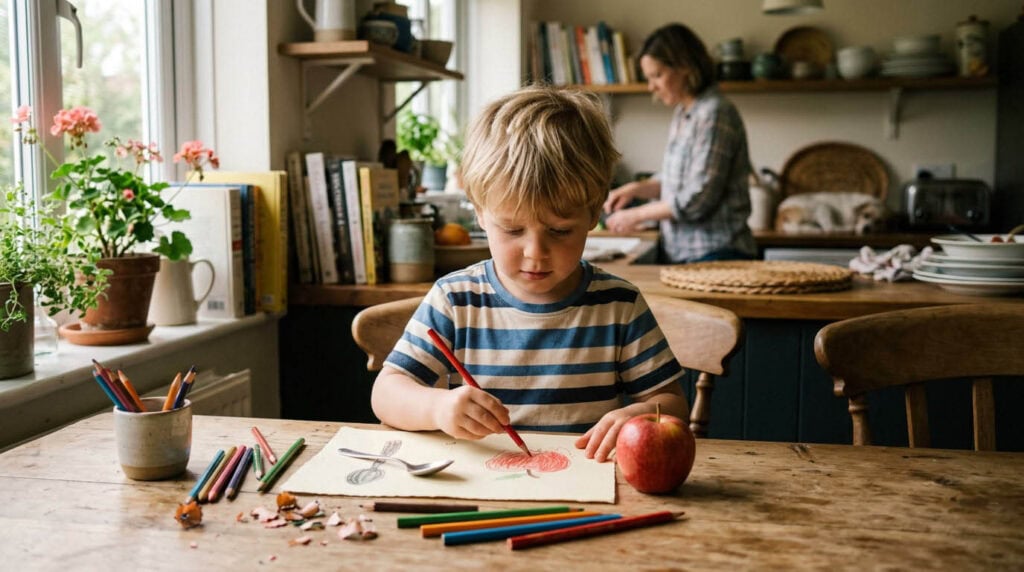
Something From the Kitchen
How it works: Your child thinks of something from the kitchen—a pot, spoon, apple, or refrigerator—and draws it. If possible, let them take a quick look in the kitchen and choose an object.
Tip: They can bring the object to the table and use it as a reference.
My Favorite Spot at Home
How it works: Your child thinks about where they most like to sit, relax, or play and draws that exact spot.
Tip: It might be the couch, a windowsill, the bed, or a corner of their room.
Yesterday in One Picture
How it works: What was the most important or best part of yesterday? Your child draws it—as much or as little as they want, all on one sheet of paper.
Tip: Ask a simple question: “What’s the first thing you remember about yesterday?”
Best for: generally from around age 4
An Animal You’ve Never Drawn Before
How it works: Your child thinks of an animal they’ve never drawn before and draws that one. The result doesn’t need to look a certain way.
Tip: The short moment of deciding is already part of the activity.
Something Soft
How it works: Your child thinks of something that feels soft—a pillow, teddy bear, cloud, or cat—and draws it.
Tip: This works well for younger kids because the subject can come straight from everyday life.
Something That Moves
How it works: What moves? Wind, a rolling ball, a jumping dog, flowing water—your child chooses and draws.
Tip: They don’t need to explain movement in the picture. Just let them draw whatever comes to mind.
Something That Makes a Loud Sound
How it works: Your child thinks of something loud—thunder, a drum, a barking dog, or a fire truck—and draws it.
Tip: One simple question is enough to start: “What’s the loudest thing you know?”
Something Red
How it works: The color is the starting point, not the subject. Your child thinks of something red and decides what to draw.
Tip: You can use any other color in exactly the same way.
Something With Teeth
How it works: An animal, monster, crocodile, zipper—anything with teeth or something that looks like teeth is fair game.
Tip: Your child can make the teeth extra big and noticeable if they want.
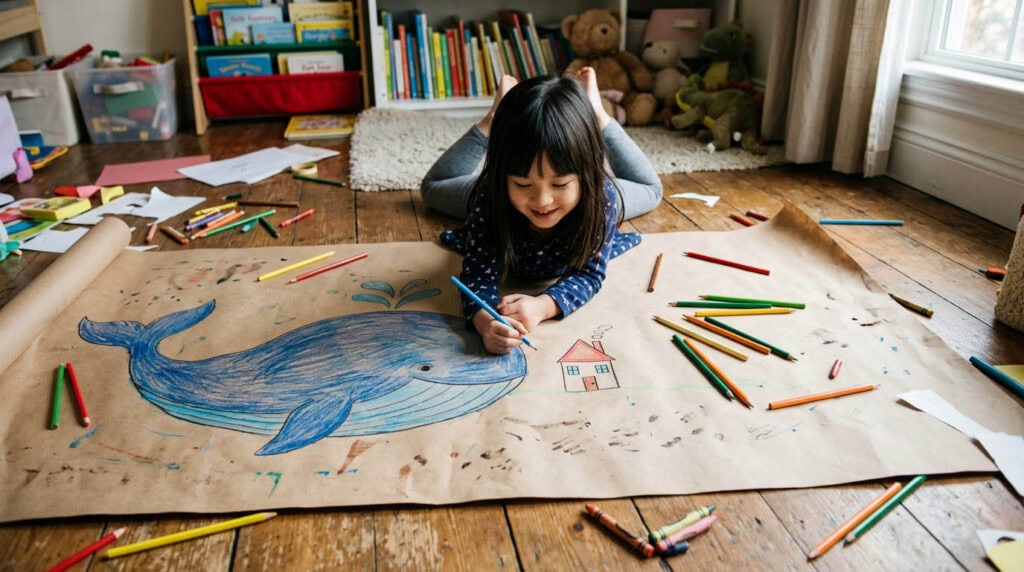
Something Bigger Than a House
How it works: Your child thinks of something truly huge—a mountain, a whale, or a cloud—and draws it. Adding a small house next to it helps show the size difference.
Tip: The size comparison is optional, but it can make the picture especially fun.
Something Smaller Than a Fingernail
How it works: Your child thinks of something tiny—a beetle, ant, or sugar crystal—and draws it large on the paper.
Tip: Encourage them to make the tiny object as big as possible.
Something You Find at Night
How it works: The moon, stars, sleeping people, dreams, lanterns, nocturnal animals—your child chooses something from their own idea of nighttime.
Tip: Don’t limit the activity to real things. Imaginary nighttime creatures are welcome, too.
Something in the Snow
How it works: Your child imagines a winter scene and draws what is happening in it. Real or imaginary—both work.
Tip: This is a natural fit for winter, but it also works in summer as an imagination prompt.
My Favorite Piece of Clothing
How it works: Your child thinks of the piece of clothing they like to wear most and draws it—with its patterns, colors, and details.
Tip: They can bring out the actual item and use it as a reference while drawing.
Drawing Challenges – 18 Ideas
Drawing challenges revolve around one clear rule or limitation. The fun comes less from what to draw and more from the small constraint—a shape rule, a color limit, a time limit, or an unusual way of drawing. That turns drawing into a little experiment.
One Continuous Line
How it works: Your child draws a subject without lifting the pencil from the paper even once. Their hand can move freely, but the pencil stays in contact with the paper the whole time.
Tip: Don’t specify a subject—the result is always a surprise.

Draw With Your Other Hand
How it works: Your child draws any subject using only the hand they don’t normally use.
Tip: The result is meant to be funny—there’s no pressure to make it look “good.”
Best for: generally from around age 3 or 4
Circles Only
How it works: The entire picture is made only of circles—big, small, overlapping, or side by side. No other shapes or lines are allowed.
Tip: Finger paint or a thick marker can make this especially easy for younger kids.
Straight Lines Only
How it works: Only straight lines are allowed. No curves or wavy lines—and the goal is still to create a complete picture.
Tip: For an extra challenge, try drawing an animal using only straight lines.
Wavy Lines Only
How it works: The entire picture is made only of wavy lines. No straight lines and no closed shapes.
Tip: Show your child what a wavy line looks like, then let them jump in.
5-Minute Drawing Challenge
How it works: Name a subject or let your child choose one, then start the timer. After five minutes, the drawing is finished—wherever it happens to be.
Tip: This works well as a warm-up when your child is having trouble getting started.
Slow as a Snail
How it works: Your child draws any subject—but as slowly as possible. The hand barely moves: no rushing and no speeding up.
Tip: For the opposite challenge, draw the same subject as fast as possible right afterward.
As Fast as You Can
How it works: Name a subject, then have your child draw it as fast as their hand can move. No pausing, no overthinking—just go.
Tip: A shaky, imperfect result is exactly the point.
Draw With Your Eyes Closed
How it works: Your child closes their eyes, you name a subject, and they draw it without looking. They can open their eyes once the pencil leaves the paper.
Tip: The result is usually funny—even for very young kids, because there’s no expectation that it should look a certain way.
Mirror-Image Drawing
How it works: Your child draws one half of a subject—for example, a butterfly or a face—then tries to draw the other half as symmetrically as possible.
Tip: Fold the paper lightly down the middle and draw a faint center line as a guide.
Best for: generally from around age 4
One Color Only
How it works: Your child chooses one color and uses only that color for the entire picture—all shapes, areas, and details.
Tip: They can vary pressure and intensity to create differences while still using just one color.
Three Colors Only
How it works: Choose three colors—by rolling, drawing slips, or simply picking them. Those are the only colors your child may use for the entire picture.
Tip: Set out the three chosen pencils or crayons and move the rest aside.
As Small as a Postage Stamp
How it works: Your child draws a complete picture, but it has to fit inside a tiny pre-drawn area.
Tip: Draw a small rectangle on the paper and keep the entire picture inside it.
Best for: generally from around age 4

Fill the Whole Page
How it works: Your child draws a subject so large that no border is left empty. The picture has to fill the whole sheet.
Tip: Thick markers or finger paint make this especially striking.
Draw With the Paper Upside Down
How it works: Place the paper upside down on the table. Your child draws a regular subject while the sheet stays turned around, then rotates the paper the right way up only at the end.
Tip: Try it together and compare the results afterward.
Best for: generally from around age 4
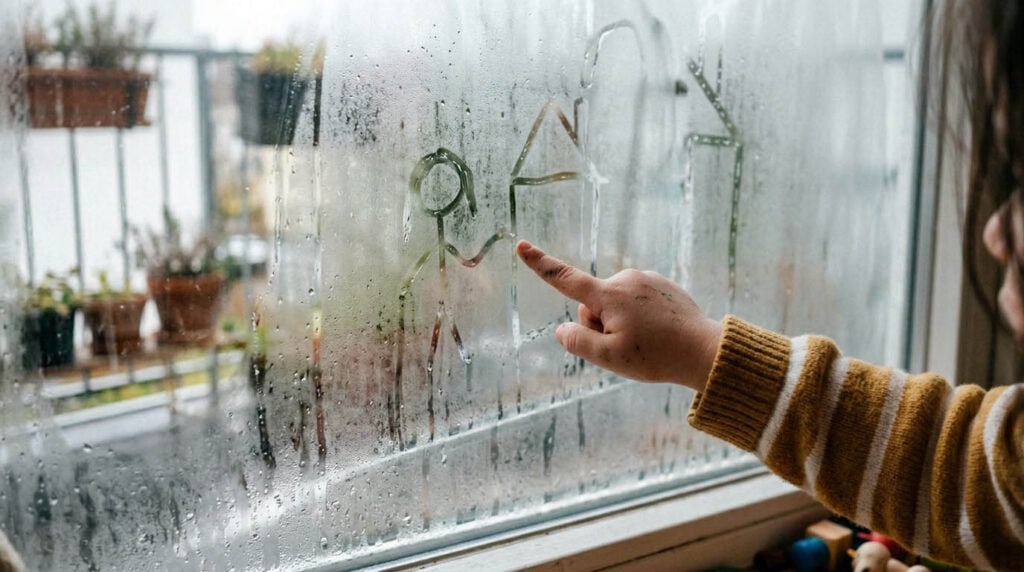
Use Your Finger, Not a Pencil
How it works: Your child creates a picture using only their index finger—either with finger paint or on a fogged-up window. No pencil or marker is allowed.
Tip: This is especially good for younger kids because no special technique is needed.
Paint on a Vertical Surface
How it works: Tape a large sheet of paper vertically to a wall or door. Your child paints while standing, with their arm moving in the air—a very different experience from working at a table.
Tip: A wide brush or finger paint works especially well.
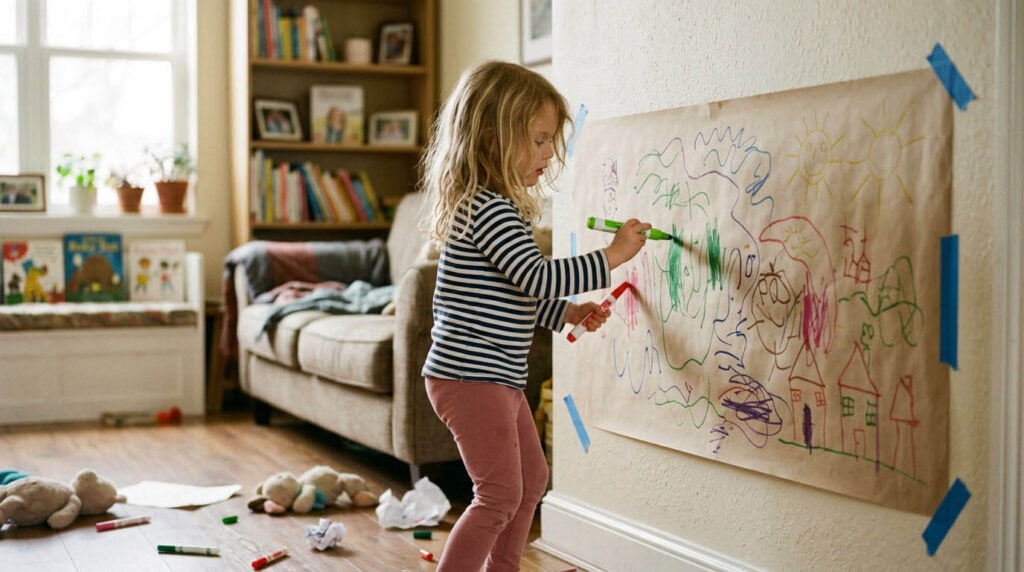
Paint on the Floor While Standing
How it works: Place a large sheet of paper on the floor. Your child stands upright over it and paints without sitting down or leaning for support. The movement comes from the shoulder rather than the wrist.
Tip: Finger paint or a wide brush works well for younger kids—protect clothing first.

Drawing Games – 13 Ideas
Drawing games put the play element first. They may include rounds, rules, guessing, or taking turns with other people. These ideas are especially useful when drawing is meant to become a shared activity.
Take-Turns Drawing
How it works: Put one sheet of paper in the middle. Each person takes a turn adding exactly one element—an animal, a tree, a cloud, or anything else that comes to mind. No one plans the whole picture; it develops together by chance.
Tip: Don’t discuss what to add. The surprise is part of the fun.

Guess the Drawing
How it works: One person silently draws a subject while the other watches and tries to guess what it is before the picture is finished.
Tip: Choose simple subjects so younger kids have a fair chance to guess.
Best for: generally from around age 3
Drawing Telephone
How it works: Person A draws something and shows it briefly. Person B looks at it, then redraws it from memory. Person C does the same, and so on. At the end, compare the first and last drawings.
Tip: You’ll need at least three people. It gets especially funny with a larger group.
Drawing Relay
How it works: Two people work on the same subject, taking turns for only 30 seconds at a time before passing the paper. The result is a shared drawing that neither person controls on their own.
Tip: Use a clock or phone as a timer so each switch comes unexpectedly.
Best for: generally from around age 4
Yes-or-No Drawing Game
How it works: Person A thinks of an animal or object and may only draw. Person B asks yes-or-no questions and tries to guess. Person A answers only by adding new details to the drawing—not by speaking.
Tip: Agree on the rule beforehand: drawing only, with no nodding or shaking your head.
Best for: generally from around age 4 or 5
Drawing Bingo
How it works: Each player gets a blank 3×3 grid. Read out a list of simple subjects. In each round, everyone draws one subject in an empty square. The first player to get three in a row wins.
Tip: Write the subjects on slips of paper together, fold them, and draw them at random.
Best for: generally from around age 4

Memory Drawing
How it works: Person A draws something for 30 seconds, then turns the paper over. Person B may look at it for only three seconds, then redraws it from memory.
Tip: Choose simple subjects so the memory part stays manageable.
Best for: generally from around age 5
Stop-and-Guess Drawing
How it works: One person draws freely while the other watches. At any point, the watcher says “Stop!” From then on, the picture may not be changed. Then the other person guesses what it was becoming.
Tip: Say “Stop!” early sometimes—it makes the game harder and funnier.
The Forbidden Subject
How it works: Person A names a subject that Person B is not allowed to draw. Person B still creates a complete picture while trying to stay as far away from that forbidden subject as possible.
Tip: At the end, talk about how close the picture came to the forbidden subject.
Best for: generally from around age 4 or 5
Same Subject, Two Drawings
How it works: Both people get the same subject and start drawing at the same time without looking at each other’s work. Compare the results at the end. The point is not who did it “better,” but how differently the two pictures turned out.
Tip: Try using the same drawing tools and the same size paper to make the comparison even more surprising.
Rapid-Fire Drawing Challenge
How it works: Person A rapidly calls out lots of elements one after another. Person B has to fit all of them onto one sheet of paper as best they can, without pausing.
Tip: Let the speed and number of items create the challenge—the final picture is allowed to be chaotic.
Best for: generally from around age 4
One Pencil, Two Hands
How it works: Two people hold the same pencil at the same time and draw together without deciding who will guide it where. The picture grows from the movement of both hands at once.
Tip: This is especially nice for a parent and child—the shared pencil literally connects the activity.

Can You Spot Your Own Drawing?
How it works: Everyone draws the same subject on separate sheets of paper. Shuffle the drawings and place them face down. Turn them over one at a time and have everyone guess who drew each one.
Tip: You’ll need at least three people. This works well for families or small groups.
Drawing Activities for Two – 13 Ideas
These ideas are designed for two people—a parent and child, siblings, or friends. Sometimes both people draw at the same time, sometimes they take turns, and sometimes one person continues what the other started. Either way, they create something together.
Keep the Drawing Going
How it works: Person A starts with a line, shape, or outline and passes the paper over. Person B adds whatever comes to mind, then passes it back—without discussing a plan.
Tip: This works well for a parent and child. The adult can start with a simple shape or line.
Left Half, Right Half
How it works: Divide the sheet of paper in half. Person A draws the left half and Person B draws the right, without seeing what the other person is doing. Reveal both halves together at the end.
Tip: Agree briefly on one shared theme, then draw separately.
Best for: generally from around age 4

One Describes, One Draws
How it works: Person A imagines a scene and describes it in words without showing it. Person B listens and draws from the description. Compare the result at the end.
Tip: A parent can take the describing role and give the child clear details to turn into a picture.
Best for: generally from around age 4
Draw Each Other’s Portraits
How it works: Sit across from each other and draw each other’s faces—as they really look or however you choose. Put the two portraits side by side at the end.
Tip: There’s no pressure to make them look alike. The differences are often the funniest part.
Create a Busy Scene Together
How it works: Put a large sheet of paper in the middle and take turns adding elements with no plan or fixed order. The goal is simply to make the page as full as possible.
Tip: This is especially fun for siblings—the more details, the better.
One Draws the Outline, the Other Colors It In
How it works: Person A draws a clear outline—an animal, house, or piece of fruit. Person B gets the paper and colors it in however they like, without planning it together first.
Tip: This works especially well when a younger child is the one coloring, because the outline gives them a clear starting point.
Take Turns Drawing a Picture Story
How it works: Person A draws the first picture in a story. Person B draws the next: What happens afterward? Keep taking turns until you have five or six pictures.
Tip: Line up the pictures at the end and tell the whole story together.
Best for: generally from around age 4
One Draws, the Other Makes Sounds
How it works: Person A draws while Person B makes sounds to match—animal noises, weather sounds, engine sounds, and more. The drawing should respond to what they hear. Then switch roles.
Tip: This works especially well for younger kids because the sound-making role requires no drawing skills.
Find-and-Fix Drawing Game
How it works: Person A intentionally draws something “wrong”—a house with no door, a dog with six legs. Person B has to find and fix every “mistake,” but only by drawing, not by talking.
Tip: For more fun, make some of the mistakes small and hard to spot.
Best for: generally from around age 4
Giant Floor Drawing
How it works: Put a large sheet of paper on the floor and have both people kneel or lie beside it. Agree briefly on a shared theme, then each person adds their own part freely.
Tip: This works especially well for siblings—the bigger the paper, the better.
Hide-and-Seek Picture
How it works: Person A draws a complete picture and hides one small element in it—a tiny frog in the grass, a star behind a tree. Person B has to find it.
Tip: Write down the hidden item on a separate slip of paper beforehand so there’s no disagreement later.
Best for: generally from around age 4
Outside and Inside
How it works: Person A draws the outside of something—a house, backpack, or animal. Person B uses a separate sheet to draw what might be inside. Put the two pictures together at the end.
Tip: Seeing the two ideas together is the best part.
Best for: generally from around age 4
Read-Aloud Drawing
How it works: An adult reads a short story aloud while the child draws what they hear. There’s no expected result—each child can draw whatever the story brings to mind.
Tip: Read slowly and calmly so there’s enough time to draw.

Creative Drawing Prompts – 18 Ideas
Creative drawing prompts are open-ended imagination starters. There’s no game system and no restriction—just one idea that helps your child begin drawing freely. There’s no single “right” result.
Invent an Animal That Doesn’t Exist
How it works: Your child combines body parts from different animals or invents something completely new. A hybrid, a monster, or something entirely original—anything goes.
Tip: If they’d like, they can name the animal and explain where it lives.
Invent a Fruit No One Has Ever Seen
How it works: What would a fruit look like if no one had ever seen it before? Does it have spikes? Does it glow? Does it taste like three things at once? Your child invents it and draws it.
Tip: Give the fruit a name, too—it makes the idea feel even more complete.
An Animal That Never Gets Cold
How it works: Your child invents an animal that lives in ice and snow but never gets cold. What does it look like? What does it have that other animals don’t?
Tip: There’s no right or wrong answer—every solution can be interesting.
An Animal With a Strange Job
How it works: A frog as a hairstylist, an elephant as a mail carrier, a penguin as a chef—your child chooses an animal and a job and draws the scene.
Tip: For a random combination, put animal names and jobs on separate slips of paper and draw one of each.
What’s Behind the Secret Door?
How it works: Give your child a sheet of paper with a door already drawn on it—or let them draw the door themselves. Anything can be behind it.
Tip: The door provides a simple frame while everything beyond it stays open-ended, which works well for younger kids.

What Lives Under My Bed?
How it works: Friendly, adventurous, or fantastical—your child draws whatever they imagine under the bed. It doesn’t have to be a monster. It could be treasure, a tiny town, or a sleeping animal.
Tip: Give them a moment to come up with their own idea before offering suggestions.
A House on the Moon
How it works: What would a house look like if it weren’t on Earth? What would it need? What could you see from there? There are no wrong answers.
Tip: The same idea works with other planets or imaginary places.
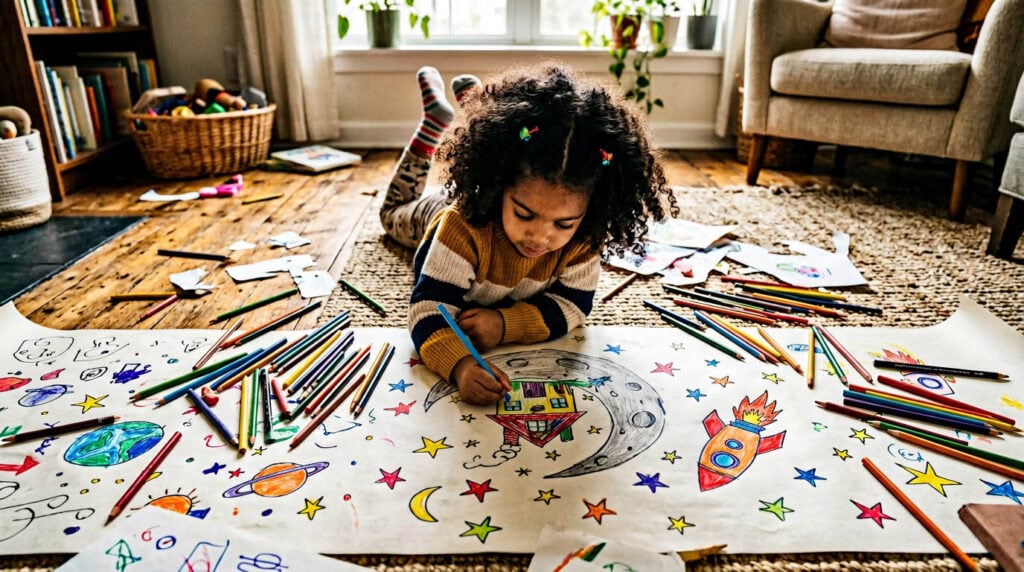
A City Where Only Animals Live
How it works: What would animals build if they had a city of their own? What would their houses look like? Your child designs the world.
Tip: Start small—one house in the animal city is enough to begin.
Best for: generally from around age 4
What’s Deep in the Ocean Where No Human Has Been?
How it works: Your child draws what they imagine in the deep ocean—animals, plants, buildings, light, or anything else. There are no wrong answers.
Tip: They can draw the ocean from the outside and gradually fill the underwater space with more and more details.
What Does a Flying Garden Look Like?
How it works: Imagine a garden floating in the air. How does it stay up? What grows there? Does the water fall downward? Let your child draw freely.
Tip: No explanation is needed—just ask the question and let the idea grow.
A Tree With Something Other Than Leaves
How it works: Instead of leaves, the tree grows stars, socks, candy, eyes, eggs, or anything else your child imagines. The tree is the fixed starting point; everything else is open.
Tip: Draw a simple tree outline first if your child would benefit from an easy way into the imaginative part.
A House Made Entirely of Food
How it works: Bread walls, a chocolate roof, candy windows—your child draws a house in which every part is made of food.
Tip: Ask which parts of the house they’d want to eat first. That makes the picture more personal.
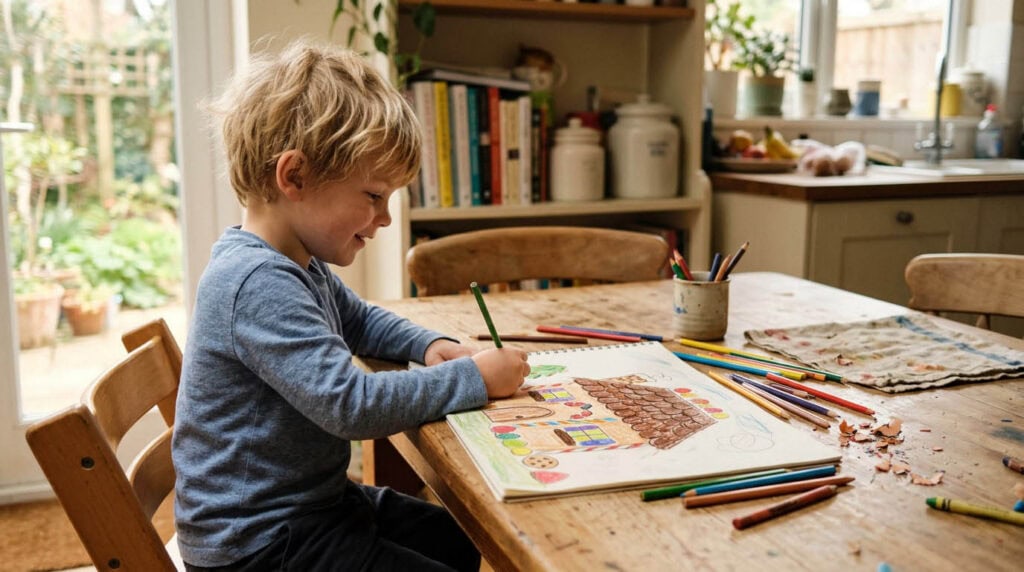
What Does a Giant Keep in Their Bag?
How it works: Your child imagines what could fit inside a giant’s enormous bag and draws the bag with everything in it.
Tip: The bag can be shown open or from the inside, like a busy scene full of details.
What Does a Dragon Pack in Its Lunchbox?
How it works: What does a dragon eat? What would fit in its enormous lunchbox? Your child draws the inside of the lunchbox and everything packed inside.
Tip: Dragon foods can be fiery, strange, or funny.
Mail From an Underwater World
How it works: A fish writes a letter or sends a picture. What does it show? What matters in its underwater world? Your child draws the contents of the message or picture.
Tip: They can add an envelope made of seashells or seaweed, too.
My Dream Place
How it works: Your child draws a place where they would most like to be—real or imaginary. There’s no “right” result; they can simply start wherever the idea takes them.
Tip: Begin with one question: “Where would you most like to be right now?”
Draw What Music Sounds Like
How it works: Play a short piece of music. While listening, your child draws colors, shapes, and lines that express what the music makes them feel or imagine. The drawing doesn’t need to show a recognizable object.
Tip: Try a calm piece and a lively piece one after the other, then compare the results.
Best for: generally from around age 4

Draw to the Music – Pencil Up, Pencil Down
How it works: While the music plays, your child draws. As soon as the music stops, the pencil has to leave the paper. The music—not the child—decides when drawing starts and stops.
Tip: Choose music with pauses or stop it yourself at unexpected moments to give the picture a surprising structure.
Random Drawing Ideas – 14 Ideas
In these random drawing ideas, chance helps decide the color, subject, mood, or task. The surprise is the whole point. Many work well for one child, and some are also fun with two people.
Drawing Dice Game: Roll for a Color
How it works: Assign a number to each color. Before your child draws a new part of the picture, roll the die—the number determines which color to use. Your child chooses the subject.
Tip: Keep a small color-number key on the table.

Pick a Drawing Prompt
How it works: Write simple drawing subjects on small slips of paper, fold them, and place them in a bowl or bag. Your child picks one slip and draws what it says.
Tip: Prepare the slips together—the writing and folding are already part of the fun.
Three-Word Random Drawing
How it works: Make three stacks of slips: animals, places, and types of weather. Draw one slip from each stack. Your child draws the combination—for example, a penguin in the desert during a rainstorm.
Tip: The more unexpected the combination, the more fun the picture can be.
Best for: generally from around age 4

Three Words, One Picture
How it works: Pick three slips of paper—one animal, one object, and one place. All three have to appear clearly in the finished picture. Your child decides how they fit together.
Tip: There’s no set scene. The three elements can be arranged any way your child wants.
Turn a Random Dot Into Part of the Picture
How it works: Your child closes their eyes and makes one dot somewhere on the paper. That dot has to become part of the finished drawing—it might turn into an eye, a window, or a star.
Tip: This works especially well for younger kids because the dot gives them an instant starting point.
Two Random Dots – Start and Finish
How it works: With eyes closed, your child makes two dots on the paper. The first dot is the start of a line and the second is the finish. The final picture has to include that connection.
Tip: Add a third dot as a required detour if you want another twist.
Turn a Random Shape Into a Picture
How it works: An adult draws a completely random closed shape on the paper—nothing recognizable. Your child turns that shape into a picture, and the original shape must remain visible as part of the result.
Tip: The stranger the shape, the more interesting the possibilities.
Paint-Blot Drawing
How it works: Put a blot of paint on the paper. Your child turns the page, looks at the blot from different directions, and asks: What could this be? Then they draw around and into the blot to turn it into a picture.
Tip: This is great for younger kids because every result can become something interesting.

Roll the Die: How Many Things?
How it works: Roll the die once. The number tells your child how many different things have to appear in the picture; they choose what those things are.
Tip: If a six feels like too much, roll again.
Best for: generally from around age 4
Roll the Die for a Mood
How it works: Write down six moods—for example, sad, excited, cozy, funny, spooky, and sleepy. Roll the die to choose the mood. Your child chooses the subject, but everything in the picture should fit that mood.
Tip: Come up with the six moods together to make the game more personal.
Roll the Die: Big or Small?
How it works: A roll of one to three means drawing the subject as tiny as possible. A roll of four to six means drawing it as large as the paper allows. Your child chooses the subject.
Tip: Roll twice and draw both versions of the same subject—it’s fun to compare them.
Blind Target
How it works: Your child closes their eyes while an adult points to a spot on the paper. That spot becomes the target: your child draws a complete picture with the chosen point exactly in the center.
Tip: After the drawing is finished, mark the original spot with a small circle and check it together.
The Letter Chooses the Subject
How it works: Pick a letter card or use a die-based system to choose a letter. Your child draws anything that starts with that letter.
Tip: If your child doesn’t know every letter yet, simply tell them which letter was chosen.
Best for: generally from around age 4 or 5
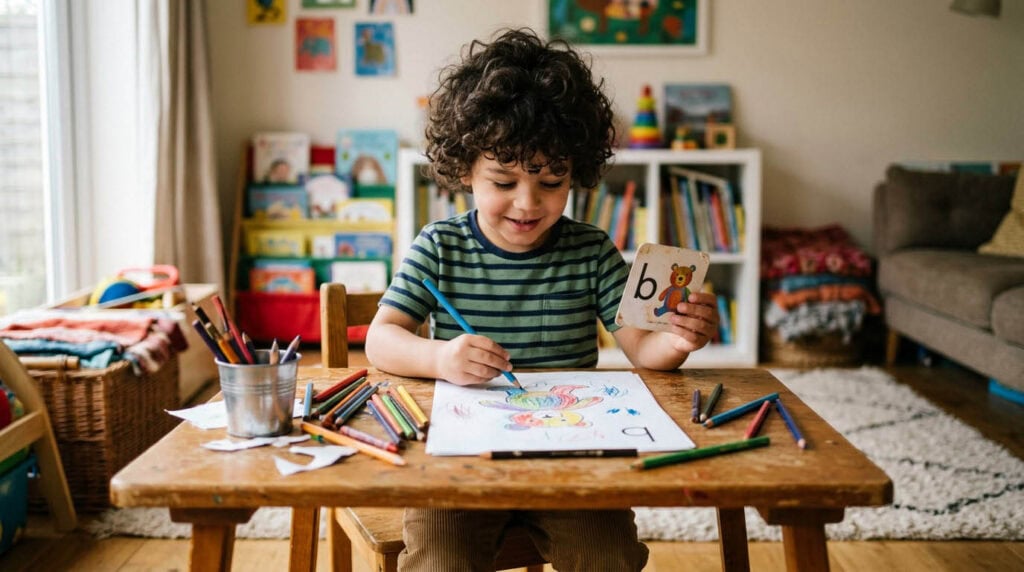
Ten-Second Look
How it works: Show your child a picture—a photo or book illustration—for ten seconds, then take it away. Your child draws what they remember seeing.
Tip: Choose simple, clear images. Too many details can make the activity unnecessarily difficult.
Best for: generally from around age 4